Cape Town makes its mark on world map for water reuse
17 February 2025
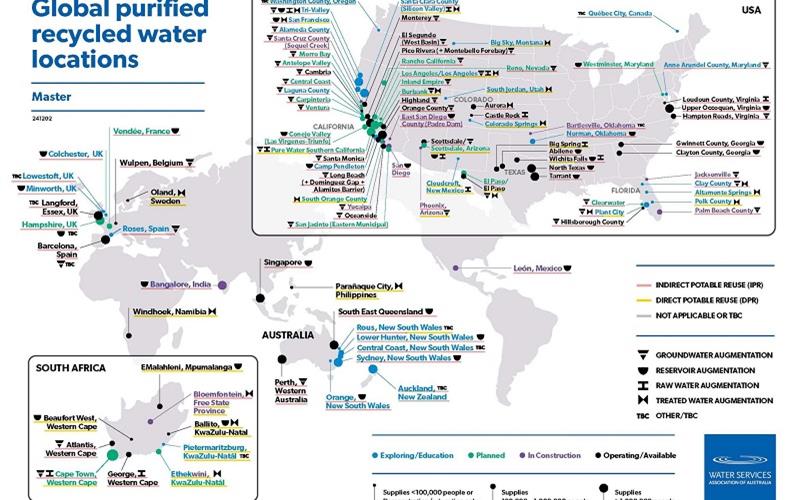
Three of Cape Town’s water supply schemes (the Atlantis Water Resource Management Scheme, Cape Flats Managed Aquifer Recharge Scheme and Faure New Water Scheme) have been added to the world’s largest online data-map showcasing water reuse projects from around the globe.
In December 2024, three of the City of Cape Town’s water reuse schemes were added to the Global Connections Map, compiled by the Water Services Association of Australia (WSAA), in partnership with the USA’s WaterReuse Association.
The interactive online tool spotlights locations where 100 drinking water reuse schemes are situated worldwide.
There are currently 35 cities where water reuse projects are plotted, which are either planned, built or already in operation. This illustrates how several international communities now rely on water reuse, as part of their strategy to sustain drinking water supply.
‘Cape Town is not alone in its efforts to augment water supply through alternative sources. Globally, purified recycled water is already part of the drinking water system for 30 million people,’ said the City’s Mayoral Committee Member for Water and Sanitation, Councillor Zahid Badroodien.
Implementing potable water reuse means that wastewater will be treated through an advanced water purification process, until it can be safely used again for drinking. The City of Cape Town has been exploring this method combined with other water sources, as a way to help secure enough drinking water in the supply network into the future.
More about the City of Cape Town’s sites featured on the Global Connections Map:
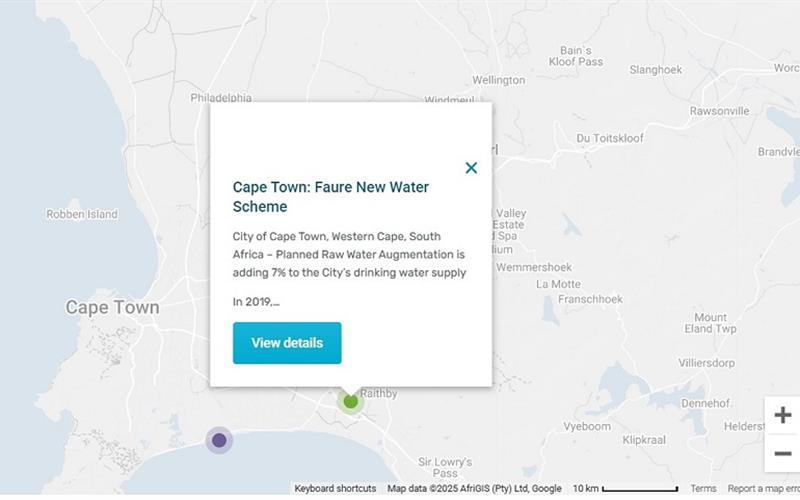
1. Faure New Water Scheme (planned) is a direct potable reuse scheme that will produce 70 million litres (upgradable to 100 million litres) of drinking water per day. The project is currently in the design phase. The scheme will convert highly purified source water from Zandvliet Wastewater Treatment Works into safe drinking water that meets international quality standards. This requires an advanced water purification process involving multiple technological barriers (ozonation, biologically-activated carbon filtration, granular-activated carbon filtration, ultrafiltration, ultraviolet advanced oxidation and disinfection). Once purified, the water will then be blended with dam water and treated again at the existing Faure Water Treatment Plant, before being distributed through the City's drinking water supply network.
2. Atlantis Water Resource Management Scheme (operating) is a ground water scheme that includes a managed aquifer recharge (MAR) component. The managed aquifer recharge includes the infiltration of conditioned stormwater and treated effluent into strategic zones of the aquifer, to ensure sustainability of the aquifer biome over the long-term. The Atlantis scheme currently produces 13 million litres per day and is being optimised to produce 25 million litres per day in the medium-term. In the long term, it can be expanded to produce 40 million litres per day.
3. Cape Flats Managed Aquifer Recharge (under construction) is a component of the Cape Flats Aquifer Management Scheme. The scheme includes abstraction of groundwater from the Cape Flats Aquifer and the MAR component, which consists of injection of treated effluent into the strategic zones of the aquifer, to ensure sustainability of the its biome over the long-term. This scheme is anticipated to produce 54 million litres of drinking water per day.
‘Cape Town is investing more in infrastructure than Johannesburg and Durban combined, with a capital budget 91% larger than Joburg and 117% larger than eThekwini over the next three years. Water and Sanitation represent 42% of our approximate R120 billion 10-year infrastructure pipeline, funding critical projects from our New Water Programme that will produce 300 million litres of drinking water daily by 2030. Unlike other metros, Cape Town is proactively securing its water future through innovative solutions that ensure resilience against climate change and population growth.’ said Mayoral Committee Member Cllr Zahid Badroodien.
Cape Town’s New Water Programme
The New Water Programme is a strategic response to Cape Town’s increasing water needs and climate variability. By introducing multiple water sources, the programme aims to add 300 million litres per day to the city’s supply. The key initiatives include:
Water reuse: The Faure New Water Scheme will be a state-of-the-art water reuse project that will produce up to 70 million litres of drinking water daily. Public participation on outsourcing the implementation and operation of the facility begins in March 2025.
Desalination: The Paarden Eiland Desalination Plant, currently in the planning phase, will use multi-barrier treatment technology to remove pollutants and salts, ensuring the production of high-quality drinking water. The City launched a public participation process on 31 January 2025, on outsourcing the implementation and operation of the facility, with feedback submissions open until 3 March.
Clearing of invasive plant species: The removal of invasive alien plant species is a cost-effective way to free up billions of litres of water in Cape Town’s key catchment areas. The removal of non-indigenous, water-guzzling plants is an important component of the City's Water Strategy and long-term NWP, which aims to add 55 billion litres per year to the water network.
Groundwater abstraction: Tapping into aquifers to secure over 100 million litres per day.
Caption 1: Global purified recycled water locations at various stages of completion, plotted on the Water360 website.
Caption 2: Cape Town’s planned Faure New Water Scheme now included in the international listing.
End
Published by:
City of Cape Town, Media Office